State of the City 2026
Published on April 03, 2026
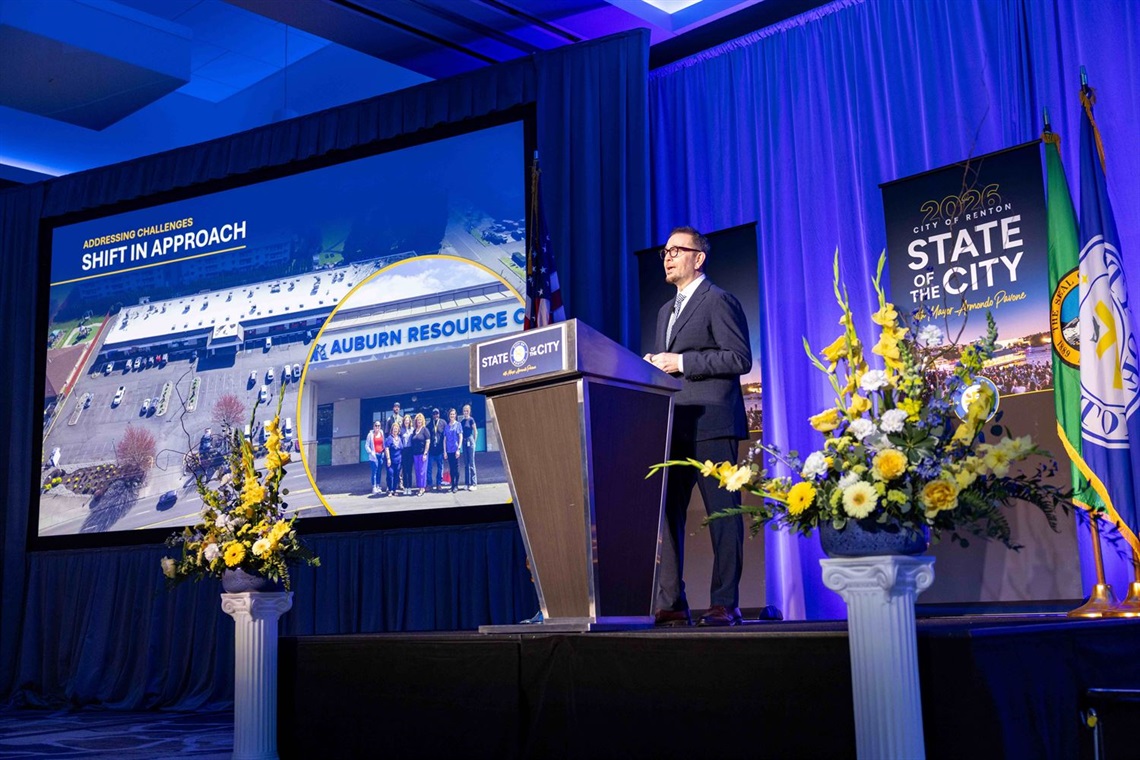
On Wednesday, March 25, Mayor Armondo Pavone delivered the 2026 State of the City address. This was our second year hosting at the beautiful Hyatt Regency Lake Washington at Seattle’s Southport, and we couldn’t imagine a better setting for this event. Full presentation below:
Thank you for joining us tonight. Please welcome to the stage your King County Executive, Girmay Zahilay.
Good evening everyone. Can we turn this off so we don't have to look at my face the whole time? Thank you so much. Good evening. How's everybody doing? Good to see you, Renton.
Welcome to the Renton State of the City. It's such an honor to be here with all of you. My name is Girmay Zahilay. I'm your King County Executive. Yeah. Thank you. I know many of us associate ourselves with living in a city and a state and a nation, but did you also know that you live in a county? Did you know that? If you look across the water, you might see Mercer Island, and Bellevue, and Seattle. If you look to the south, you'll see Kent and Federal Way. Those are all connected through an intricate set of systems and staff called King County government.
I represent 39 cities across this vast and beautiful region. And I will tell you that Renton is a very special place to us. Renton is a very special place to me personally. Thank you. I grew up in an unincorporated area called Skyway just to the north of here and that is within Renton's urban growth boundary. So I grew up coming to Kmart. Anybody remember Kmart? Yeah. Got my first bike from there. Used to hang out here. My Deputy Executive stand up Deputy Executive stand up. Karan Gill is a product of the Renton School District. So, your highest levels of leadership, our South King County Manager, you're here, Ryan, for some reason, I just blanked like I don't play basketball with him every Sunday. Ryan Quigtar, stand up. He is our South King County manager. Before coming and working for me, he was the executive director of an organization called Renton Innovation Zone Partnership, RIZP. Anybody heard of that organization? Yes.
So, a lot of Renton representation in our administration and in our personal history. This is such a special city. It's one of the fastest-growing and most diverse cities in the whole region. And we have a lot of work to do to make sure that you all have the housing, the health, the transit, and all of the infrastructure needed to live the best possible lives as a community.
And as your county executive, I am committed to working with your local leadership to make that happen.
We all know that county government cannot function properly without strong collaboration with local government, with the city partnership. So, I want to shout out our Renton City Councilmembers. Are you in the space right now? Stand up. Renton City Council, stand up. Say hello.
I see some back there as well. Valerie, Carmen, I see back there. Thank you all so much for being here. Your county government will be a good partner to you as well as your mayor.
We also understand that we have to be showing up, forming relationships with communities beyond the local government. That's what I have tasked Ryan to do who will be here regularly forming relationships with Renton community, the nonprofit community who's in here. Non-profit community, make some noise. I know a lot of you are out here serving the community very effectively, getting to know the businesses. Business community, make some noise. Are there business community partners out here? So good to see you all.
So we will continue forming those relationships to deliver the best possible services to all of you. And we've already been working with our local cities right here in Renton. We've announced partnerships and projects on transit, on healthcare, on emergency management. On transit, I was proud to join many of our local mayors and elected officials at the state level. I see Representative Hackney here as well. I see our local mayors. I see our Kent mayor. I see our Auburn mayor. I see my King County Council colleague Steffanie Fain here to break ground on the Rapid Ride I-line, which is going to provide fast reliable, frequent service from Renton to Auburn to Kent and all the way in between. And that's an example of a project that is a partnership between King County Metro, our local cities, our state partners and beyond.
I was also proud to have my teams join for the groundbreaking of the Renton Transit Center, which will provide more transit through Sound Transit. We also have partnerships through housing and behavioral health. Affordable housing is a program where we allow people to live in permanent supportive housing. 105 units is right here in Renton through the Sydney Wilson House.
Another example of a partnership between King County and Renton for the benefit of our unhoused neighbors is to make sure that they have a roof over their heads and behavioral health wraparound services. Another example of a strong partnership is through, of course, emergency management. Emergency Management is critical. We all experienced those devastating floods here in December, and we had strong partnerships with our city partners through our emergency management, emergency operations center which is actually located in Renton. It's located in Renton and it's the epicenter of our region's emergency management systems. So, another example of county government working with city governments to deliver the life-saving services that our communities need and deserve, and we will continue doing that on behalf of all of you. Thank you.
I will say that when I look out into the future, there are so many amazing things coming to our region. We're going to be connecting east and west and south parts of our region through the cross-lake connection coming up here this weekend. We're going to have FIFA World Cup. We're going to be bringing the Sonics back as many of you saw in the announcements.
All of these incredible opportunities are on the horizon and it's such a beautiful time to be in King County and to live in Renton where you all have such strong and valuable leadership under the leadership of your fantastic Mayor Armondo Pavone. The State of the City is strong under his leadership, and it is my honor to welcome him and offer county government as your partner for as long as you serve. Thank you so much, sir.
Give him another round of applause.
Thank you, sir. I don't think I need that. Well, good evening. Let me get my setup here. Give you that. Well, thank you, Girmay, very much for that introduction.
It's great to have you here tonight. You know, it really can't be overstated the importance of a good partnership between our cities and the county. We're looking forward to what we can accomplish together, and thank you once again for that introduction. Really appreciate it. Before we get started, I want to give a big shout-out to the musicians that were here earlier. Steve Aliment and Annie O'Neill. Can we give them another round of applause there?
Give you a little history. Steve Aliment actually has Renton roots. The Aliment family, I believe, his grandfather immigrated from Italy to Renton years ago. And his uncle, Frank Aliment, was actually our mayor years ago, so there's quite a Renton connection between that band. Another side note, he was also in a rock band that used to play for our high school called ‘No Cheese Please’ for the older people in the audience, you might remember that band from the 70s.
So, well, good evening everyone and thank you for joining us. I'm Armondo Pavone and it's my honor to serve as the mayor for the City of Renton.
This is my second term as mayor and my 13th year serving as an elected official. Before I became mayor, I served for six years on the Renton City Council. I'm deeply grateful for the opportunity to continue giving back to this community. It's a position of trust that I take very seriously, and it's also why I make it a priority to remain available to each one of you, not just tonight, but throughout the year.
For those of you who have not had the chance to meet me, Renton has been my home my entire life. I graduated from Renton High School, built my business here, and I choose to raise my family here. So, when we talk about issues facing our city, they're not just abstract. They directly impact my family just as they impact yours. And speaking of that, I'm going to get in trouble for this, but my family's here, and I want to introduce them. My wife, Angela, and my two boys, Roman and Dominic.
Thank you for being here in support. I'd like to take a moment to recognize our city council. I know that Girmay called out a couple of them, but I'm going to call everybody's name and please stand. As I call your names out, start this year's council president, Ruth Pérez, Ruth, please stand up. Council President Pro Tem Ryan McIrvin, Councilmember Ed Prince. Valerie O'Halloran, I believe, is in the back. Councilmember Kim-Khánh Văn. Councilmember Carmen Rivera. And last, but certainly not least, Councilmember James Alberson Jr.
I'd also like to recognize our city leadership team. First, our Chief Administrative Officer, Ed VanValey. Stand up wherever you are. Deputy Chief Administrative Officer, Kristi Rowland.
And the administrators of each department who are here tonight, please stand up.
It's our city leadership team there. Thank you very much. Our boards and commissions are set to provide community input on policy decisions throughout the year. I'd like to take a moment to recognize you for your time and dedication to the city of Renton. Please stand. All everybody that's on boards and commissions, please stand up. Give you a round of applause.
Thank you very much for your service. During my time in office, we've seen significant growth and change. In many ways, it's an entirely different landscape than when I first ran for council.
Today, we're addressing challenges that weren't even on the horizon back then. And yet, through all of that, Renton remains grounded in a strong foundation built on financial stability, thoughtful policy, and a strong, engaged community. We now see the results of years of planning and investment come to life. At the same time, the challenges we face are more complex than they were 20, 10, or even 5 years ago. That foundation is important because it allows us to think long term, act strategically, and invest in our future.
Our focus is clear: preparing for growth, building infrastructure for tomorrow, strengthening public safety, and continuing to invest in the spaces and services that define our community. Our commitment to excellence shows up in the work being done across the city.
This year, our finance team earned a recognition both statewide and nationally for excellence in budgeting and financial reporting. This is significant because we are one of only 11 agencies out of 400 that received this level of recognition.
It was a really big deal. Our planning team earned a VISION 2050 award for their work on transit-oriented development. And our Public Works team received a Gold Award for Innovation on the Monroe Avenue infiltration facility, the largest of its kind in Western Washington.
Recognition certainly isn't the goal, but awards like these are the natural byproduct of a culture focused on accountability, innovation, and doing what works the right way.
The people working for you are leaders in their field. They take pride in what they do, and it shows. That's why we work to attract and retain the top talent. And that investment in people pays dividends in everything we accomplish. In my last State of the City, I discussed right-sizing our staffing levels to match the population growth we've experienced. One of the important parts of staffing is carefully selecting the right team to carry out the vision. Our staff are respected experts in their field, known for their contributions in Renton and the region and the state.
We're exceptionally well-positioned financially. We continue to carry an AAA bond rating. This means we're prepared for unexpected costs and time-sensitive opportunities. Renton is in a unique position. In recent years across the state and country, many governments have faced tough budgets. They've laid off staff, delayed projects, and cut costs. That hasn't happened here. We've had extremely strong economic growth. We've been responsible and transparent about our spending and conservative in our estimates on projected income. Our state auditor even said Renton has created a culture of accountability. We have clear intentions with our budget and we keep those guidelines.
Our budget includes significant investments that meet the needs of our community, create a positive shift in our trajectory, and have a lasting impact on future generations. Shaped by a robust outreach effort and the community's input, our 2025-2026 budget set three priority areas.
- Increase funding for public safety and human services
- Maintain and improve city infrastructure, and
- Increase staffing to support city objectives
And we're seeing that strategy work. While some areas are experiencing a 5 to 7% decrease in sales tax revenue, Renton has remained stable, a good indicator of economic strength. That stability allows us to keep other tax rates low while continuing to invest in our community.
A key part of our financial strategy is how we maximize every dollar. We've adopted a more proactive collaborative approach to pursuing grants by forming a city-wide team that identifies and prepares for grant opportunities that can move projects forward. The results. In 2025 alone, the City of Renton received nearly 27 million in grant funding to support key projects across the city, including the Rainer Avenue Phase 4 project, the Kenndyale Lakeline replacement project, Legacy Square, and affordable housing developments.
Our efforts to maximize every dollar have real impacts and allow us to do more without placing additional tax burden on our community. Because of our strategic financial approach, we've been able to implement our community's priorities at a faster pace. We've purchased property for our new resource center. We've secured the former Stoneway site to move the Tri-Park Master Plan forward and expand park space along the Cedar River. And we've made substantial progress on upgrades to the Renton Municipal Airport. None of these things I've mentioned are small feat on their own. It's all thanks to responsible financial strategy that we can proceed with these strategic long-term investments and that's exactly how we intend to continue.
Another important part of our foundation is our strong business community. If you don't know, Renton is home to 3,600 businesses located in the city and over 71,000 come to Renton for work each day. It's a mix of global corporations like Boeing and small businesses across the city that make the backbone of our economy. Across the board, we've continued to see growth in our employment base. There's a reason for this. We create a strong environment for business to thrive. We provide supportive structures including the Startup 425 entrepreneur incubator program, our small business liaison team, and we provided incentives for employers to relocate to Renton.
Our B&O tax rates are competitive, making our community a preferred choice for businesses opening or expanding. We efficiently manage our utility service to produce the best possible service rates with an average household cost of around $115 a month. That's one of the lowest in the region. This keeps overhead costs low for our commercial customers and utility bills down for our residents. The revenue from B&O and sales tax help to fund infrastructure and services the city provides.
There are several different taxing authorities that cover Renton, but the average city property tax on a home in our community is about $642 per year. While I know that your property tax is higher, the city receives only about 8.3 cents of every dollar you pay. Here's a breakdown of how the property tax is allocated. While we've kept property tax rates steady in Renton, there have been increase due to voter-approved levies over the past few years. Locally, the City of Renton's rate have stayed consistent and even decreased slightly over the last year. We expect this graph to change slightly in the upcoming year for several reasons. For example, in 2025, voters approved Proposition One, the Hospital Benefit Authority Levy for Valley Medical, which will increase property tax rates by 46 cents per thousand of assessed value on homes in the region.
Beyond direct taxes, we also work hard to keep rates low for public access to our high quality assets, such as Henry Moses Aquatic Center, which offers a great summer experience, and Maplewood Golf Course, which offers one of the best values in our region for a municipal golf course.
I've talked a lot about our financial strategy and business community as a piece of our foundational success. But our greatest asset by far is you, our community. And when I'm out talking with you, I hear a consistent message. You want to celebrate what makes Renton special. A great example would be welcoming back clam lights at Coulon. We hosted cultural celebrations throughout the year, and in 2026 we'll celebrate the 40th anniversary of Renton River Days and the 125th birthday of the city. We'll also look forward to welcoming visitors from around the world during the FIFA World Cup, which will be an incredible opportunity to showcase our city on a global stage.
Since taking office, one of my core priorities has been returning to the fundamentals of what it means to serve. That means providing the highest level of customer service. It means actively seeking input and listening. And it means making a deliberate effort to hear from those who may not have always come forward on their own. Our responsibility is to serve members of this community. This year, we've taken our commitment into our neighborhoods, creating more opportunities to connect with you directly, hear your concerns, and have real conversations about our future.
Overall, you're telling us that Renton's quality of life is strong and that the city is moving in the right direction. You feel our tax dollars are being used responsibly, especially for utilities, parks, and recreation. You value timely and accurate communication, and you have confidence in our police department's performance and response. At the same time, you've been clear about where we need to improve.
Safety remains a top priority, particularly after dark. Housing affordability remains a challenge especially for our young people, seniors, and renters. And we're also hearing something else that's important. Our younger residents, those between 18 and 35, are the least connected and among the least satisfied. That shows we need to do more to make those connections and bring them into the conversation. Although we still have work to do this year, we've made significant improvements in how we communicate with you. We've shifted to a more real-time approach. In our newsroom, you can now find updates as they happen. No sign-up, no newsletter required. On our website, you can now ask questions, and leave comments, and engage directly with the work we are doing. You can connect directly with the people closest to the work who are the best equipped to provide you with clear, accurate, and up-to-date information.
Because our goal is simple, to make sure you have the real story and a direct line to share your perspective. Our surveys show that almost as many people get their information from social media as from the web. So, we're adapting by meeting you where you are. I'm also glad to see our Civic Academy graduates here tonight. The Civic Academy graduate program has been a great example of how stronger communication leads to stronger community.
We also invest time in several ways to have those important in-person conversations. Each summer, I make it out to as many neighborhoods as I can to talk to you about your concerns, share future plans, and answer questions with you over Talks on the Block, a new series. I'll come out to your driveway, talk with you and your neighbors for an hour or two, and bring along experts and our staff to discuss what you're interested in. You can sign up here. Would love to come out. You'll also see our Chief Administrative Officer, Ed VanValey, out at What's Brewing with Ed series each month.
Ed would love to see you at a What's Brewing with Ed session sometime soon. You can also connect with Ed or me, or you can show up for a listening session hosted by our neighborhood program. We've been intentional about creating easily accessible opportunities for public input on city project and there's several open right now. There's a great schedule on our website and I would love to see each person here at one of those events.
One of the benefits of a forward-thinking and publicly accessible staff is that Renton is prepared. In advance of the World Cup, a once-in-a-lifetime opportunity, we heard questions about the number of visitors we expect to host. Staff have been working on all fronts to prepare for this summer, planning to welcome visitors, creating opportunities for residents and businesses, and providing proactive safety measures.
Last but not least, you will find helpful short-form information what we do to prepare year around on social channels like this clip from our very own Engineer Joe.
A social media star in the making for sure.
As I mentioned at the start of tonight's event, this is not the same world as when I first started on city council. The challenges we face today are different and our approach has to evolve with them. What I hear most from you is that you want the city to find new solutions and quickly address changes. Every generation faces its own set of challenges. What's different now is the pace and scale of change. Communication has shifted rapidly to social media with consumers wanting information available at the touch of their fingers. The rise of online shopping has fundamentally changed how local businesses operate. Some of these challenges are outside of our control. Things like affordability pressures and national politics. But many of them shape the environment we're operating in. And we must be ready to respond.
Renton itself has changed significantly. Since 1990, we've seen substantial population growth. Between 2000 and 2010, the number of residents we serve doubled, and that growth continued. Today, our community is younger, more diverse, and evolving. Renton is now one of the most diverse cities in the nation. That means we're making decisions for a very different community than we were 35 years ago.
We're also seeing major shifts in how people live and work. The rise of online shopping has created challenges such as impact on local retail and issues like package theft. The change in consumer behavior has affected our local economy. Also, remote work has shifted demand for office space. Rising wages have created both opportunities and pressures for particularly for small businesses. At the same time, the standards we've set as a community through our building and maintenance codes still matter. Those standards reflect long-standing expectations for how our community wants Renton to look and feel. And when those standards aren't met, we have systems in place to address it.
Our code enforcement team plays an important role in maintaining those expectations across the city. But in a changing economy, we also recognize that some spaces that were once active may no longer serve the same purpose. We've seen strong economic growth in areas like the Landing, while other commercial spaces are facing new challenges. This creates opportunity, opportunity to reimagine how that space is used to support new types of businesses and to adapt to changing needs. It isn't always simple, but as a city, we have the tools, experience, and processes in place to navigate these changes and position Renton for what comes next.
We're aware of the challenges we're facing and continue to look for new ways to address them, including graffiti. This year, we shifted our graffiti response from the police department to our community and economic development team, enabling a more proactive and coordinated approach. That team has launched two new initiatives, a daily citywide abatement program and our Paint with Purpose program.
Through Paint with Purpose, you can now see new examples across the city, turning spaces that were once repeatedly tagged, into artwork the community can take pride in. We're also taking a more direct approach with property owners. When we identify locations with reoccurring graffiti, we reach out and offer a selection of paint colors so they can be quickly addressed when it appears. It's a simple, practical, and low-cost solution. And more importantly, it's working.
Public safety remains our top priority and when we look at the data, context matters. For example, the total calls for service were down in 2025 and into 2026, but that doesn't necessarily mean crime is down.
It could reflect fewer incidents are being reported. We're also seeing a decrease in juvenile crime. At the same time, we know fewer charges are being filed in those cases, which adds another layer of complexity to the data. In other areas, we're seeing encouraging trends like decline in violent crime, robbery, and auto theft. But there's been an increase in DUIs and traffic-related infractions.
So, while the numbers show movement, they don't always tell a simple story. What they do tell us is this. As demands shift, so does our response. With fewer calls related to serious violent crime, our officers have more capacity to focus on proactive enforcement in other areas, helping to improve safety across the city.
Making sure these teams are properly staffed and supported is critical to keeping our community safe. At the start of our last budget cycle, we identified a clear staffing gap. Renton was about 47% below the national average and 8% below the Washington state average for officers per resident. Closing that gap and implementing efficient, effective strategies are essential to meeting our public safety goals.
Within the Renton Police Department, we've built specialized teams to respond to the complexity of today's challenges. Our C-squad focuses on the most violent repeat offenders. Our special enforcement team and our direct enforcement team lead long-term investigations targeting issues like human trafficking, the flow of illegal drugs, and other significant issues that have serious impacts on our community safety.
We're also responding to a broader range of challenges, especially impacts of the opioid and behavioral health crisis. These crisis’ have contributed to a rise in chronic homelessness and an increase in encampments across the city. These are not simple issues, and they require us to be thoughtful in our response. As a city, we operate with important checks and balances. Major changes involve coordination between the council staff and our partner agencies. That process matters, but it also can make pivoting, rapid pivots, more difficult. The reality is being nimble in government doesn't always look smooth. But even when progress feels incremental, those decisions shape our trajectory for years to come. The choices we make today will define where Renton is in 10, 20, or 50 years.
One of the most visible challenges we're facing is the continual impact of encampments. On the surface, it can appear to be a public safety issue, but it's more complex than that. Addressing it requires a layered approach, one that balances enforcement, compassion, and accountability. That includes connecting people to services and support. It also means exploring stronger accountability measures such as minimum sentencing policies and tools like SODA, which are ‘Stay Out of Drug Areas, which allow us to restrict repeat offenders from areas known for drug activity.
Beyond policing efforts, we understand that addressing community issue is complex and multifaceted. To improve our response, we aim to make data-driven decisions. This is especially important as we assess our efforts to combat homelessness and support those affected. And when we step back and look at the broader picture, the trends are deeply concerning.
Between 2014 and 2024, Washington has become an outlier nationally. When it comes to mental health and addiction, we now rank first in the nation for overdose deaths, where we're 227% higher than that national average. Fentanyl overdoses in Washington are 45% higher than in Nevada, the next highest state. Across multiple measures tied to substance use and homelessness, we've seen increases ranging from 2 to 500%.
In just two years, between 2021 and 2023, our chronically unhoused population grew by more than 400%. There's a quote I think about a lot. Without data, we're just another person with an opinion. And what the data tells us is our current approach is not working. We've continued to invest in contracted services at continually increasing levels without seeing meaningful reductions in chronic homelessness. We've also seen firsthand the outcomes of approaches like no-barrier shelters. It's important that we get this right. These people who are suffering and in need of care, but also in many cases they've declined services or assistance multiple times. It's clear that continuing to do the same thing will not produce different results.
A few cities across our region are beginning to pivot. I've been watching the approach the City of Auburn has taken for several years. Their model emphasizes outreach built on relationships, empathy, and trust, often led by people with lived experience. And they're seeing results with higher rates of successful transition into housing than most other cities in King County. And that's the kind of approach we need to learn from and build upon.
So we are currently working towards a centralized resource center that brings together shelter, wraparound services, and coordinated support in one place. Addressing this challenge requires both compassion and accountability, but most importantly, a clear path forward for people to move out of homelessness and into stability.
So where do we go from here? Our next steps are more than a vision. We've already spent the last year laying the foundation for what comes next. That work includes acquiring the site for our future resource center at the former Compton Lumber property and beginning in the buildout of staffing, programming, and construction for the center.
This is a priority for us, and our teams are working at full speed to deliver this facility as soon as possible. And I want to thank our council for their partnership in helping bring this resource center to life. We're also taking a deeper look at solutions, especially in prevention.
That means upstream investments connecting people to services like mental and behavioral health services and housing assistance before they fall into crisis. One example of that work is the city's investment in the startup of the Renton Student Health Hub, a partnership with the Renton School District and Health Commons that helps identify families at risk and connect them with early support.
Beyond our own community, decisions are being made that have direct impact on us. It's important Renton has a seat at the table to advocate for our city.
One of my advocacy positions over the past few years has been to highlight unintended consequences for the City of Renton. Policy decisions made in D.C., Olympia, or King County impact residents, businesses, and community. This affects our approach to public safety, homelessness, housing density, and even parking requirements in your neighborhood.
Keeping decisions local enables us to better position to respond to Renton’s unique needs rather than one-size-fits-all approach. I've been involved with policy development with the Sound Cities Association for the past 10 years. SCA represents collective voices of the cities besides Seattle here in King County. This year, I'm serving as the president of SCA Board of Directors. Our focus is working collaboratively with our neighbors, elected officials, and legislators at all levels to serve our city well.
To that end, I have several people here tonight that I can't imagine doing this job without, and I want to make a few announcements. Mayor Nancy Bakus is with us here, Mayor Dana Ralph, Councilmember Steffanie Fain, Councilmember Hackney, Tom from Tukwila, Sean from Maple Valley. I know I'm missing people.
I can't imagine doing this job without your support, thank you very much.
I know I missed somebody. Regional partners like Executive Zahilay and King County councilmember Steffanie Fain and Reagan Dunn, and mayors like Dana Ralph, Nancy Backus from Auburn.
It's not a question of whether we'll face challenges. Cities are constantly evolving. They grow, they contract, they change. The question is how we respond to those changes and challenges. The real test for any city is the ability to adapt, to pivot, and to move forward in changing times. Every city faces pressures. The difference is how we choose to respond. And we are well-positioned to respond in new and innovative ways. If we plan for stagnation, that's where we run into trouble.
Instead, we have to plan with the future in mind. When we look at long-term investments, we're making decisions that won't just address today's challenges, but will shape Renton for decades to come. These decisions aren't always easy. They often involve tough conversations, competing priorities, and yes, sometimes a little discomfort.
But history shows us why these decisions matter. The acquisition of the land for the expansion of Coulon Park in the 1960s may seem like a no-brainer today. But at the time it was a lot of money for a small city and a very difficult choice. Now it's one of the most cherished and well-used public spaces in our city.
Moving the car dealers from downtown to Auto Row was another major shift, one that ultimately helped redefine and strengthen our downtown core.
Years ago, the city chose to preserve the small-town feel over the potential of what light rail could bring to the future. Looking back, we missed an opportunity. That decision continues to shape some of the challenges we're working to overcome today. The lesson is clear. The decisions we make now will define our future. It's up to us whether we impact it positively or negatively. If we want to create new challenges for the next generation, that's why we have to be forward-thinking in how we invest.
Our decisions are guided by long-range planning, expert analysis, data, and best practices across the country. Just as importantly, those decisions are also shaped by public input at every stage. Because the investments we make today in housing, economic development, transportation, parks, and public safety are what will carry Renton forward and continue to build on the strong foundation we've created together.
This past year, we've seen continued growth across our city. In the Highlands, Solera is nearing completion, bringing a total of 680 new housing units online. We'll also see construction on the Towns on 12, adding 90 townhomes to that area. And we'll continue to invest in affordable housing, supporting projects like Willowcrest and Steele House, which will serve families experiencing homelessness and survivors of domestic violence.
On the commercial side, we're bringing new life to key spaces. We're welcoming Winco Foods to the former Fry’s electronic site and construction will begin on the new Renton Transit Center at Rainier and Grady. But that's not all. We're also seeing continued evolution at the campus, the Longacres campus. It's now the world-class facility headquarters for the Seattle Sounders and Seattle Reign and will play a key role during this summer's World Cup activities. Longacres is also the new home of the Alaska Airlines global training facility, where thousands of employees will begin their careers and more will return regularly for training.
That kind of activity creates real ongoing impact for our local businesses. We've also seen Boeing reaffirm its long-term commitment to Renton with decades of production ahead and continued investment in our community through partnerships like the Renton Schools Foundation and the Renton Promise. And across the city, momentum continues. From Wizards of the Coast expanding its presence as the global gaming headquarters for Hasbro to the opening of new hotel brands like the LiveAway Suites and the announcement of the future campus for the Seattle Children's Hospital here in Renton.
We're positioning ourselves for sustained investment in the years ahead. We expect to see more than 20,000 new jobs in the coming years. To support that growth, we've built out dedicated economic development team focused on recruiting new businesses, activating vacant spaces, and working with regional partners like the Kent Valley Aerospace to ensure the long-term strength of our aerospace industry. That team is also helping us think differently by exploring opportunities within our municipal code, supporting property owners and adapting to changing market needs, and expanding our internal capacity, including adding code compliance manager this year. All of this points to the same thing. Renton is not standing still. We're building for what's next.
In February, Sound Transit broke ground on the former Sound Ford site on Grady Way for the new Renton Transit Center, which is scheduled to open in 2028. This is a major milestone for our city and one we've been working towards for years. When it opens, Renton will serve as a key regional hub and be positioned as the central link between South King County and the east side, connecting riders to the Tukwila light rail station, Burien, Bellevue, and beyond. This is bus rapid transit, essentially light rail on wheels. Electric double-decker buses will run every 10 to 15 minutes, up to 17 hours a day, providing fast, frequent, and reliable service. That level of access and frequency changes how people move. And just as importantly, it creates new opportunities here at home. With the transit center relocating, we're going to have the opportunity to reimagine our current downtown footprint, creating a more walkable, active, and connected environment.
Our transportation and planning teams have been working closely to bring that vision to life, transforming the Rainer and Grady corridor into a true transit-oriented development. One of the things that brings together housing, retail, restaurants, and small businesses, all built around a transportation system that supports how people live and move today.
We've also been focused on bringing our vision to life in the downtown core. This has been years in the making. It dates back to moving car dealerships to Auto Row and reflects the work of many mayors and councilmembers. Committed to creating a downtown that's both welcoming and functional. Community outreach began as early as 2009. Then in 2006 under former Mayor Dennis Law and the city council, the first Downtown Civic Core Action plan was formally requested. I was proud to be part of the council at the time and I know there are others here tonight who are part of that effort as well in 2018.
The council adopted the plan shaped largely by input from businesses, property owners, and the community in total. And since then, we've been steadily advancing that vision. At its core, this project is about activation, bringing consistent energy, activity, and purpose to our downtown spaces. With the addition of the new market, this area will be active seven days a week. Along the way, we've also taken advantage of good opportunities.
Years ago, we acquired the former Big Five site, and this year, we turned that long-vacant property into a key piece of this vision, supported in large part by grant funding. And the timing couldn't be better. As we look ahead to the World Cup, this space will play a key role in welcoming visitors and drawing activity into downtown, delivering an immediate return on investment. But the long-term impact is even greater.
This will become a true arts and culture hub, hosting events year-round and becoming a destination for residents and visitors. We anticipate the completion of the Piazza, Renton Market, and Legacy Square in time for our busy summer schedule.
As we invest in more walkable, transit-oriented downtown, we're also planning for safety every step of the way. In 2025, we implemented a new traffic safety measure by conducting speed studies and adding traffic calming improvements across the city. And in 2026, we'll adopt the Renton Safety Action Plan supported by federal funding.
This plan uses data to identify where safety improvements are most needed and to guide long-term investments in safer street design. At the same time, we're continuing to deliver real on-the-ground improvements that keep Renton connected.
Over the past year, we've advanced projects that support pedestrians, cyclists, and drivers alike. Because preparing for growth also means maintaining and strengthening our infrastructure. In 2025, we added 1.4 miles of new sidewalks, helping better connect our neighborhoods. We upgraded eight miles of roadway with pavement improvements. And we also have plans to upgrade more than 50 streets across six neighborhoods. This year, we've enhanced roadway safety with 200 miles of new roadway striping, continued critical bridge inspection to ensure structural integrity, and completed several major roadway projects while beginning others, including ongoing improvement at our Renton Municipal Airport, supported largely by grant funding. Our investments in our new equipment, like our own concrete truck, has enabled us to do more of this work in-house, increasing both efficiency and impact. All of this work reflects our commitment to building a city that is safer, more connected, and ready for the future.
This year, we also made important investments in our neighborhoods. We've replaced aging infrastructure to keep pace with growth and improve safety by modernizing our water systems to increase capacity. meet fire safety standards and serve a growing population. We've added sidewalks and improved storm water systems. And we're continuing to invest in new technology to better serve our community.
One of the most significant advancements has made been made within our police department with the launch of our drones-as-a-first-responder program. Renton has been a national leader in exploring how this technology can support law enforcement. We now have drones based strategically across the city, allowing us to respond faster and more effectively. It's a clear example of working smarter.
What stands out most is the potential of using drones to save lives. During one of the earliest drone responses, an initial report of a low priority domestic noise complaint turned into a more serious situation. The drone arrived on scene 4 minutes before the officers could get there and quickly identified a woman on the ground in need of immediate medical attention. In situations like that, minutes can mean the difference between life and death. That's the kind of impact this technology can have and why we're continuing to invest in tools that help us respond faster, smarter, and more effectively.
One of our most visible investments in the future is right in front of you, our parks. In 2025, we moved forward on an exciting opportunity to expand Cedar River Park, acquiring an additional 12 and a half acres, including riverfront access. That's a significant investment. Preserving public access to Cedar River ensures this space will serve our community, not just today, but for generations to come. It also allows us to strengthen environmental protection for the river itself, including critical salmon habitat. This is a great example of transforming a former industrial site into a clean, welcoming public space.
And acquisitions like this just don't add land. They create an opportunity to think about what these spaces can become and how they can best serve our community over time. That work is guided by our newly completed six-year Parks, Recreation, Open Space Plan, which identifies future capital investments, expanded access, and helps ensure we're meeting the needs of a growing city.
We're also seeing strong regional partnerships in this space, too. Through King County, we anticipate 60 million in funding for regional trail investments, including key connections to the future transit site and continued expansion of East Rail. These investments will strengthen pedestrian and bike connections, not just within written, but across the region, linking our community to new opportunities and neighboring cities.
The council and I are proud of the multi-agency effort that brought the Renton Promise to life. The Renton Promise program offers graduating high school seniors in Renton with the opportunity to earn a 2-year associates degree at no cost. This investment helps our young people develop skills that will benefit them in the workforce and prepare them for the success in their lives. It also helps out our Renton Technical College. A big thank you to the Renton School District, Renton Technical College, our state partners, and Boeing for making this possible.
As you can see, it's been an active year and I've covered a lot tonight. What I hope you take away from tonight is this we've built a strong foundation, and we're continuing to make Renton a place that works for everyone. In the year ahead, we'll see long-standing plans come to life. We'll find ourselves on the world stage and we're just getting started.
If you have any questions or ideas, I'm always available. Your input matters and it continues to shape the decisions we make as a city.
I want to thank you all for spending your evening with us tonight and being part of our community and the opportunity to serve as your mayor. And I would like to close by thanking our executive for showing up from King County and introducing us and talking to us about the county. And most importantly, I want to thank our communications team.
They're the team that put this together. I hope I did them proud. This takes weeks of effort and they were up all night putting this together. So, thank them very much. They did a great job. Thank you all and have a safe travel home tonight. Thank you.